Sunday, September 19, 2010

Why are healthy food advocates stumping for Pepsi?


As I wrote last month, it can get pretty annoying when your friends harass you to vote for their favorite cause to "win" a grant from the now-ubiquitous Pepsi Refresh Project.

But lately I've been especially disappointed to see so many worthy food causes jumping on this marketing-disguised-as-philanthropy bandwagon. Let's not forget that PepsiCo owns not only  Pepsi-Cola and other unhealthy beverage lines such as Gatorade, but is also the king of salty snacks. The company's Frito-Lay division owns Doritos, Cheetos, Tostitos, you get the idea.

And yet without a hint of irony, in this promotional video to get people to submit project ideas to the contest, the Pepsi Refresh Project "Food and Shelter Ambassador" Allison Arieff waxes sentimental about gardening, surrounded by nothing but greenery, not a soda or chip in sight.

Here are just a few projects that have so far been crowned winners of Pepsi Refresh grants: First, there is the Bikeloc project. Pepsi introduces the celebratory video this way:
Robert DuBois and Aaron Zueck are "potlucking across America" in one hundred days, and they're doing it on bicycles. A $5,000 Pepsi Refresh grant put them in the saddle and allowed them to collect multimedia stories of the local food movement from coast to coast.
Just $5,000, was there really no other way of raising that money? Another project also won $5,000, this time for a school garden at an elementary school. Here's how Pepsi describes it:
Jeanne Acutanza had the idea to build a sustainable garden at her kids' school, where students and locals could plant crops together and donate the harvest to local food banks. She submitted her idea, you voted, and it won a $5,000 Pepsi Refresh Grant.
And in another heartwarming kid project, a farmers market manager in Illinois featured here describes how he won $25,000 to help teach schoolchildren about eating fresh fruits and vegetables, a worthy cause for sure. But what about the mixed messages kids receive from all the promotion with Pepsi logos associated with these two projects?

Now, it's no wonder that in these hard economic times, so many groups would be desperate enough to turn to the nation's largest purveyor of processed food to try and promote the healthy kind. But what these organizations don't realize is that are really doing more to promote the Pepsi brand then they are to advance their own cause. Indeed, they are undermining the very ideals they espouse.

Moreover, these grants give credibility to the notion that we can (and should) rely on Big Food to fix our broken food system. But nothing could be further from the truth. PepsiCo is happy to spend relatively small amounts of money in exchange for getting to hitch its PR wagon to the likes of farmers markets and school gardens.

Meanwhile, the sale of junk food and soda continues unabated.

Tuesday, September 14, 2010

While we battle over ingredients like HFCS, Big Food is winning the processed food war

If there was Twitter for food only, today's trending topic would have been the Big News that the Corn Refiners Association (yes, there are lobbyists for people who refine corn) is asking the Food and Drug Administration to rename high-fructose corn syrup (aka HFCS) "corn sugar." This, the latest in the corn industry's attempts to restore the tarnished reputation of its omnipresent by-product. Tara Parker-Pope, health blogger for the New York Times, quotes Audrae Erickson, president of CRA, who explains:
Clearly the name is confusing consumers. Research shows that ‘corn sugar’ better communicates the amount of calories, the level of fructose and the sweetness in this ingredient.
Clearly the name is confusing? That must explain the PR campaign the corn refiners embarked on not long ago (cutely dubbed "sweet surprise") to un-confuse consumers. But now, focus group results in hand, industry is doing what they do even better than PR: lobby the federal government to get its way.

Saturday, September 11, 2010

Tweet Responsibly: Tips for being an effective food activist (or any other kind) on Twitter

First of all, I am no Twitter expert. But after about 6 months I've noticed a few things that drive me nuts. Because 140 characters is insufficient to explain, I'm airing my concerns in this longer format. I've been writing about the food industry, food policy, and the politics of food for about 14 years now, and as a lawyer, I take pride in being accurate about policy, as well as industry practices. While I am used to writing in long format, I also appreciate the fun of saying things quickly and succinctly.

What I love most about Twitter is sharing with, and learning from, my fellow food activists, writers, experts, parents, and just anyone who cares about the politics of what's on our plate. I love the up-to-the-minute news, blog posts, action alerts, and even the waxing sentimental about whatever local food is in season.

But what I don't like is the sloppiness that typing up to 140 characters at lightning speed can sometimes foster. Lately I have felt the urge to correct a few things being posted to Twitter. Now I realize it may be annoying when I hit reply and wag my finger, but I think accuracy is important. So if it can't be said correctly in 140 characters, than either be very vague, just give the url, or leave it alone. And here are few more rules for how to be an effective activist on Twitter:

Sunday, September 05, 2010

Why is McDonald's listed a resource for Childhood Obesity Awareness Month?


I am not a fan of any sort of "awareness" month as I find the concept trivializes important health issues. Are we only supposed to care about heart disease, diabetes, etc, during that one month of the year? And I rarely see anything of substance come from the month-long activities, just the usual ineffective educational campaigns, instead of meaningful public policy reforms. Plus many issues tend to crowd themselves into certain months, so it all becomes background noise. September is one such month. Among other causes (e.g., "cholesterol education"), September has been proclaimed "Childhood Obesity Awareness Month" by Congress and President Obama.

Tuesday, August 31, 2010

Back to school with PepsiCo stealth marketing?

I recently blogged about questions regarding how PepsiCo's voluntary beverage guidelines, announced in March, would be implemented in schools given that contracts are made at the local level. Now with back- to-school in full swing, I have even more questions about how PepsiCo may be using stealth marketing techniques to gain access to that coveted captive K-12 audience.

Today, the company announced a new program it calls Score for Your School. From the press release:

Saturday, August 28, 2010

Must-read aricles on egg recall that I did not write


In case you missed it, either because you don't watch the news, don't eat eggs, or like me, both, about 1,500 people have so far been sickened by an outbreak of Salmonella in eggs. A massive recall of half a billion eggs from two Iowa factory farms ensued. I was planning to write my own blog post on this when I realized that others have already done such a good job saying what needed to be said. So instead, I am offering up my list of favorite articles by people I already knew or have just come to admire.

Friday, August 20, 2010

Video of my MSNBC interview on egg recall

Today I was interviewed on the Dylan Ratigan Show about the massive egg recall this week, now at more than half a billion eggs, with at least 1,000 people made ill and counting. The host understood that the root cause of the problem is our industrialized, factory farm food system. The segment starts about a minute into the video clip.


Sunday, August 15, 2010

Will schools follow new PepsiCo beverage guidelines even if students want Mountain Dew?

This past March, soft drink giant PepsiCo announced with much fanfare a new global school policy. The specific guidelines, to take effect by 2012, limit the types of beverages that are to be sold in schools. According to the press release, the policy will "stop sales of full-sugar soft drinks to primary and secondary schools."

That's why the announcement last week that Union County High School in Indiana was signing on to a brand new five-year contract with Pepsi (thereby ending its exclusive contract with Coca-Cola) came as a surprise. Not the contract itself, but what one school official had to say about it. From the news article:
The new contract is expected to earn the high school and middle school and booster groups $20,000 more over five years, Union County Middle School Assistant Principal Mark Detweiler said. Prices for soft drinks will remain $1.25, but school officials expect sales to increase with Pepsi products. "Students drink Mountain Dew," Detweiler said.
They sure do, only problem is, PepsiCo says those products aren't for sale. Or are they?

Sunday, August 08, 2010

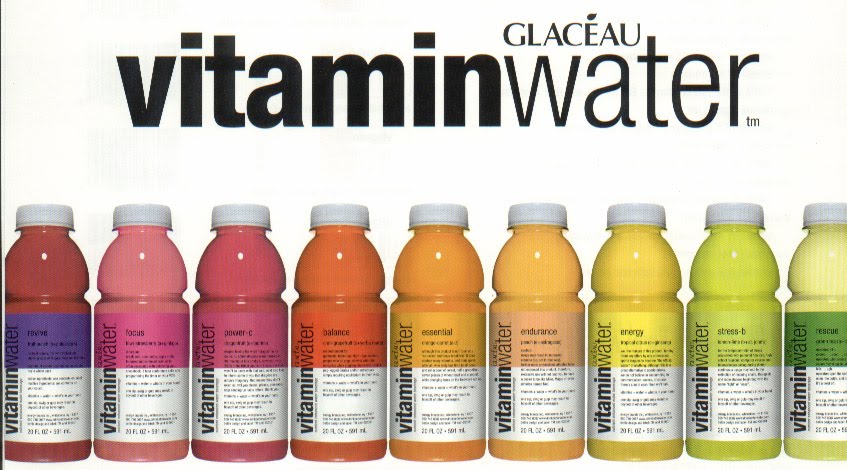
Court not buying Coke's defense of its deceptive marketing of vitaminwater as lawsuit proceeds


My friends at the Center for Science in the Public Interest (CSPI) recently scored an important court victory in its lawsuit against Coca-Cola for deceptive marketing of its product vitaminwater. (In case you missed it, the soft drink giant purchased Glaceau, maker of vitaminwater, back in 2007 for a cool $4.2 billion in cash.)

The class action, filed in January 2009 in federal court in New York, alleges that Coca-Cola's claims about vitaminwater's heath benefits are false, misleading, deceptive, and unfair. As CSPI's press release explained:
Vitaminwater's website, marketing copy, and labels claim that vitaminwater is healthy, claiming, for example, that "balance cran-grapefruit" has "bioactive components" that promote "healthy, pain-free functioning of joints, structural integrity of joints and bones" and that the nutrients in “power-c dragonfruit" "enable the body to exert physical power by contributing to the structural integrity of the musculoskeletal system."
If those claims sound like they belong on a pharmaceutical product, you're right. As CSPI notes, they go way beyond anything the Food and Drug Administration (FDA) allows "and cross the line into outright fraud." Then there's the sugar. According to CSPI, "the 33 grams of sugar in each bottle of vitaminwater do more to promote obesity, diabetes, and other health problems than the vitamins in the drinks do to perform the advertised benefits listed on the bottles."

Thursday, August 05, 2010

My latest article on AlterNet - how PepsiCo is buying up top-notch health experts

My latest article on AlterNet is entitled: "How Junk Food Giant PepsiCo Is Buying Up High-Ranking Experts to Look Like a Leader in Health and Nutrition."

And the subhead is just as fun: "Pepsi's strategy: Create a research environment so scientists and public health experts don't feel out of place at the corporate HQ of sugar, salt and fat."

You can read it there and add your comments.

Sunday, August 01, 2010

Yale Alumni Magazine covers PepsiCo / Yale School of Medicine partnership controversy


This past March, I blogged about how soda and snack food giant PepsiCo formed a partnership with the Yale School of Medicine, where I earned my public health degree. The grant included $250,000 for a 5-year research fellowship to be awarded to an MD/PhD student.

That post apparently set off a chain reaction of coverage of the deal, first in the Yale Daily News ("Critics fizz over Pepsi gift"), followed by the Wall Street Journal ("Boola Moolah! Food Fight at Yale") and on the San Francisco Chronicle health blog.

Now, in the current issue of Yale Alumni Magazine, fellow alum Carole Bass pens "Critics question Pepsi partnership," quoting me and others on the wisdom of Yale linking arms with the nation's largest promoter of sugar, salt, and fat. Adding to the irony, Yale is already home to the Rudd Center on Food Policy and Obesity, which is headed up by Kelly Brownell, a frequent critic of Big Food.

And anyway, what sort of research could possibly come of this largesse that didn't benefit PespiCo? Playing defense in the article is Yale School of Medicine Dean Robert Alpern: "There are numerous safeguards in place to protect the integrity of our research."

It's probably a bad sign when you have to use the word "safeguard" to defend taking money. Safeguards are usually for doing risky things, like skateboarding and skydiving, not philanthropy.

Alpern also responds to those who worry that the medical school's scientific principles may have been sacrificed in the name of Cheetos and Mountain Dew. Not so, Alpern assures my fellow alumni: "PepsiCo will have no involvement in who is chosen for the fellowship or the project to which the student is assigned." I for one am not assured.

The article ends aptly with a quote from Professor Jerome Kassirer, expert in conflicts of interest at Tufts School of Medicine: (Could the author find no such expert at Yale?)
The problem is that it's impossible to know whether the money given to the school can in some way have an influence on what people in the [nutrition] department might say about PepsiCo products.
And that's just for starters.

Back in April I posted the lame response I got from Yale's public affairs office upon signing a petition started on Change.org, which now has more than 1,000 signatures. But let's keep the pressure on. You can either sign the petition or email Dean Alpern directly.

And thanks to reporter Carole Bass for a job well done.

Bangkok Post covers release of Appetite for Profit in Thailand as problem spreads there


OK, so is not one my usual blog posts, but I can't help sharing my excitement. As I wrote about previously, my book has been translated into Thai, with 1,000 copies already distributed.

The translation and distribution of Appetite for Profit was commissioned by the Chulalongkorn University-based Health Consumer Protection Project, which is now releasing more copies, as was reported yesterday by the Bangkok Post. The article ("Taking a bite of out fast food: An expose details the industry's attack on food") includes graphics with pull-out quotes from the book.

If you're wondering why folks in Thailand would be interested in a book that is admittedly pretty America-centric, it seems there are warning signs that the problem is spreading there. For example, a survey conducted by the Thai Office of the Basic Education Commission found that sodas are available at 20 percent of the 20,000 schools in the country.

And this will sound familiar. Another study found some schools had agreed to allow a beverage giant to sell soda on school property in exchange for the company providing a van.

Here is how Siriwat Tiptaradol, Public Health Ministry deputy permanent secretary and the editor of the Thai version of the book explains it: "The influence of the food industry isn't limited to the US, but extends all over the world." The article also makes the case for policy change:
Developing countries like Thailand should be alert about this transnational issue and work with authorities, academics, and the public and private sectors to come up with policies to safeguard people from conditions that result from poor diet such as diabetes, high blood pressure and strokes. Otherwise, these problems will end up costing billions of baht in health care spending every year, Tiptaradol said.

A wise call for prevention before its too late.

Thursday, July 22, 2010

Family doctors debate if they should take Coke money, after they took it


In this week's Health Blog, the Wall Street Journal's Katherine Hobson asks readers to chime in on a "debate" among family doctors over the ethics of corporate sponsorship of medicine.

But first, the backdrop. Last year, the American Academy of Family Physicians announced "a new corporate partnership program" and its first partner was to be The Coca-Cola Company. Soon thereafter, about 20 doctors resigned from the organization in protest, drawing attention to the matter by Food Politics author Marion Nestle as well as advocacy groups such as the Campaign for a Commercial-Free Childhood. (Full disclosure: I serve on CCFC's steering committee.)

The grant amount was described as being in the "strong six figures" by AAFP. Here is how the group described the partnership in its October 2009 press release:
The Consumer Alliance is a program that allows corporate partners like The Coca-Cola Company to work with the AAFP to educate consumers about the role their products can play in a healthy, active lifestyle. As part of this partnership, The Coca-Cola Company is providing a grant to the AAFP to develop consumer education content on beverages and sweeteners for FamilyDoctor.org, an award-winning consumer health and wellness resource.

Wednesday, July 14, 2010

Nestle Stoops to New Low, Launches Barge to Peddle Junk Food on the Amazon River to Brazil's Poor - AlterNet article

After previously blogging about the Nestle junk food barge, AlterNet asked me to write an article on the topic. How could I say no? Please read the expanded version of this story, this time with plenty of quotes, including an NGO in Brazil working to stop this very sort of marketing.

Sunday, July 11, 2010

Happy Meal Lawsuit Update: Is McDonald's Playing Games with Nutrition Facts?

Last week I blogged about how the Center for Public Interest (CSPI) is threatening a lawsuit against McDonald's for using toys to promote Happy Meals to kids. Since then, McDonald's has responded, sort of. In a letter apparently fed to the press even before CSPI got to see it, McDonald's CEO Jim Skinner attempts to "set the record straight:"
We have a long history of working with responsible NGOs who are interested in serious dialogue and meaningful engagement; and we are open to constructive feedback.
Really? Like how McDonald's worked with those two activists in the UK by suing them for libel in the 1990s for putting out a simple brochure? The case (dubbed McLibel) spawned a book and a movie and became notorious for being the longest English trial ever, not to mention the stupidest public relations move short of New Coke.

Skinner continues to dig his own grave:
Ronald McDonald also serves as an ambassador for children's well-being, promoting messages around physical activity and living a balanced, active lifestyle.
Right. That must explain why an entire campaign was launched in March by Corporate Accountability International to Retire Ronald based on an investigation that showed how the clown's main job is to promote McDonald's unhealthy foods, in schools and just about anywhere children can be found.

Monday, July 05, 2010

McDonald's Facing Potential Lawsuit for Luring Kids With Happy Meal Toys - It's About Time

It was only a matter of time. Last month, the Center for Science in the Public Interest (CSPI) served McDonald's with a notice of its intent to sue if the fast food giant continues to use toys to promote Happy Meals. (An "intent to sue" letter is a prerequisite to filing a lawsuit in some states.) The basis for the potential case is that using toys to market to small children is unfair and deceptive under the consumer protection laws in a number of states. According to CSPI's letter, McDonald's toy promotions violate the laws of California, Massachusetts, New Jersey, Texas, and the District of Columbia. 

CSPI's litigation director Stephen Gardner explained in a statement that "McDonald's is the stranger in the playground handing out candy to our children. McDonald's use of toys undercuts parental authority and exploits young children's developmental immaturity."

Thursday, July 01, 2010

How Did PepsiCo's CEO Infiltrate the Robert Wood Johnson Foundation's Annual Report on Obesity?


Because I tend to focus my attention on news being generated by the major food companies, I don't always pay close attention to the latest scary reports on obesity data. So when the annual report called F as in Fat: How Obesity Policies are Failing America came out this week, I just thought, Oh there's that report again with the awful name, with the same gloomy numbers as last year.

But then I got an interesting email message forwarded from New York University professor and food politics maven Marion Nestle that made me realize I should pay closer attention to this year's report. The email was from Harold Goldstein, executive director of the highly effective non-profit, California Center for Public Health Advocacy. He was questioning how the CEO of PepsiCo was given 2 pages of airtime in the report. What was that? The CEO of a major company contributing to the very facts and figures contained within the 124-page document was offered space to make her case?

Saturday, June 19, 2010

All Aboard for Ice Cream: Nestle Peddling Junk Food on Amazon River to Reach Brazil's Slums


I have many things to do today and writing this post was not on my list. But as I was cleaning out my in-box, an especially disgusting news item caught my attention and writing about it is the only way I know to release my outrage. My version of screaming from the rooftop.

The offending article, on Bloomberg.com (Nestle to Sail Amazon Rivers to Reach Consumers) describes how the world's largest food company will soon "begin sailing a supermarket barge down two Amazon river tributaries as it competes with Unilever to reach emerging-market customers cut off from branded goods."

A supermarket barge? Has Big Food already run out of customers in cities and other locales that are more readily accessible by land? Cut off from branded goods? I don't think these people are lost or have been camping out too long, they're just living their lives. They probably don't even realize they are missing out on Toll House, Raisinets, and Sno-Caps. But no matter, if there are people out there so backwards to still be subsisting on food found in nature, Big Food will find them, by land or by sea, and set them straight.

The boat, with more than 1,000 square feet of supermarket space, will journey to 18 cities, reaching 800,000 potential consumers in Brazil, and will even provide access for the disabled and elderly.

Saturday, June 12, 2010

Letter from NGO in Thailand re: Appetite for Profit

At the risk of tooting my own horn, just wanted to share this really nice letter I got from the director of the Health Consumer Protection Program at Chulalongkorn University, Bangkok. They had previously requested permission to translate Appetite for Profit and distribute 1,000 copies of the book. Apparently, it's been a hit, so they need more copies, and I am happy to oblige.
Dear Ms. Michele Simon,
 
I would like to express my gratitude for your permission for the translation and the printing of translated version of the book “Appetite for Profit: How the food Industry Undermines Our Health and How to Fight Back” of which 1,000 copies were published. Free copies have been distributed to local consumer advocates and those in alternative agricultural networks in country. Apparently, the book is welcome with great enthusiasm as it has broadened the readers’ perspective on food industry system and impact of the industry’s marketing manipulation towards the public’s well-being. Such awareness will definitely help protecting Thai consumers’ right and eventually promoting their healthier eating habit.
 
As the first edition is running out so fast, I would like to ask for your permission for a reprint of yet another 1,000 copies. This lot will be distributed without any charge to the general public as well as to university libraries across the country. 
Yours sincerely,
 
Association Professor Vithaya Koolsomboon, Ph.D.
Director of Health Consumer Protection Program,
Chulalongkorn University, Bangkok    

Thursday, June 03, 2010

PepsiCo Teams up with White House to Whitewash Worthless Snack and Sodas - AlterNet article

Food and beverage giant PepsiCo claims to be "investing in a healthier future for people and our planet." But how is that possible when their top-selling products include Mountain Dew and Doritos? 

Check out my article on PepsiCo over at AlterNet. Please post comments there, if you're so inclined, since editors love that.